



Launching a new product is exciting—but without a solid business case, even the best ideas get shelved. Leadership needs confidence that your product solves a real problem, fits company strategy, and delivers measurable ROI. Whether you’re pitching a SaaS feature, a consumer gadget, or a service expansion, here’s how to build a persuasive, executive-ready business case.
1. Define the Problem and Target Customer
Start with empathy—not features. Clearly articulate:
- The pain point: “Small e-commerce brands waste 10+ hours/week manually reconciling payments.”
- Who feels it: “Shopify store owners with $50K–$500K annual revenue.”
- Why it matters: “Errors lead to cash flow gaps and accounting fees.”
Use customer quotes, survey data, or support tickets as proof—this isn’t hypothetical.

2. Validate Market Opportunity
Show there’s real demand and room to win:
- Total Addressable Market (TAM): “$2.1B in SMB accounting automation”
- Competitive landscape: “3 main tools exist—but none integrate natively with Shopify + QuickBooks”
- Differentiator: “Our one-click sync reduces reconciliation time by 80%”
Include early validation: pre-orders, waitlist sign-ups, or pilot interest from beta customers.
3. Align with Company Strategy
Connect your product to broader goals:
- “Supports 2024 pillar: Expand into SMB fintech”
- “Leverages our existing payment API infrastructure”
- “Increases average revenue per user (ARPU) by $15/month”
If it doesn’t advance strategic priorities, it’s harder to justify.
4. Present a Clear Financial Model
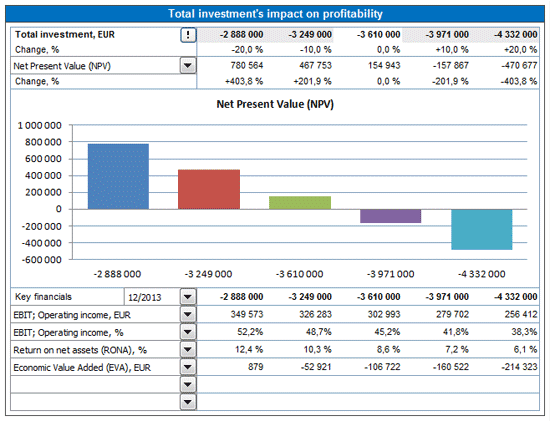
Break down costs vs. returns over 12–24 months:
- Development cost: $120K (team, tools, testing)
- Revenue projection: $300K Year 1 (based on 5% conversion of 10K target users)
- Gross margin: 75% (SaaS model)
- Break-even: Month 10
Use conservative assumptions—and show upside potential (“If adoption hits 8%, revenue = $480K”).
5. Outline Go-to-Market and Risks
Demonstrate you’ve thought beyond launch:
- Go-to-market: “Bundle with existing plans; promote via email + in-app banners”
- Success metrics: “500 active users in 90 days; <5% churn”
- Key risks & mitigations:
- Risk: Low adoption → Fix: Offer free trial + onboarding calls
- Risk: Tech delays → Fix: Build MVP with core functionality first
This shows realism—not just optimism.
FAQs
Q: How long should the business case be?
A: Keep it to 1–2 pages for initial review. Attach detailed financials or research as an appendix. Executives want clarity, not clutter.
Q: What if we don’t have customer data yet?
A: Use proxy data—industry reports, competitor reviews (“Customers complain X on G2”), or internal support logs. Then propose a low-cost validation test (e.g., landing page + ad spend).
Q: Should I include a product mockup or prototype?
A: Yes—even a simple Figma wireframe or sketch helps stakeholders visualize the solution and builds credibility.
A strong business case turns vision into viability. By grounding your product idea in real customer needs, strategic alignment, and financial logic, you don’t just ask for approval—you make it the obvious next step. Build your case with evidence, not enthusiasm—and watch innovation move from whiteboard to market.